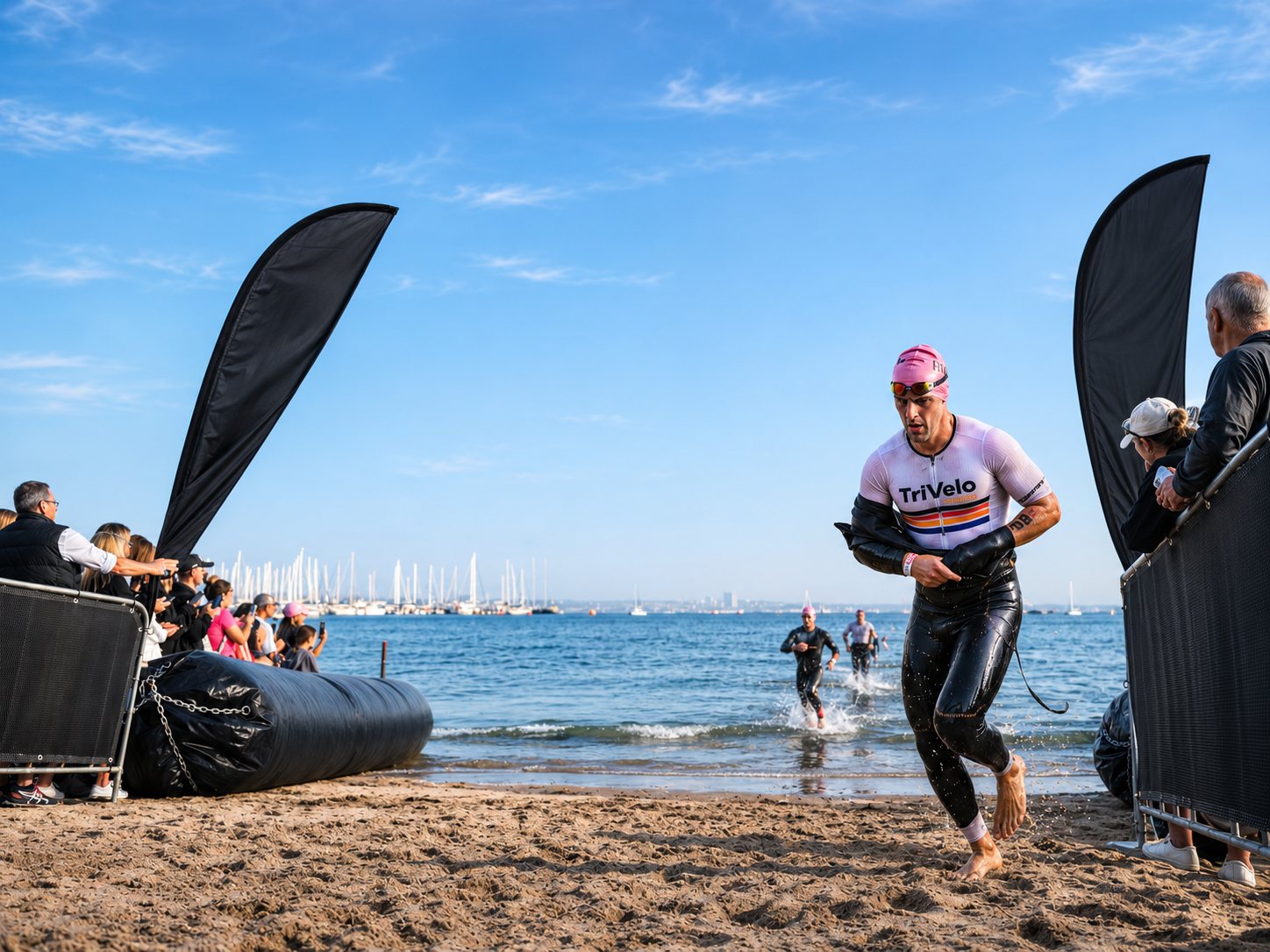
By Gerard Donnelly, head coach at TriVelo Coaching and 1988 Australian Ironman Champion, and coach Jordan Donnelly. From the Get Fast Podcast.
Heart rate zones are bands of training intensity. The simplest model has three zones, split by two points in your body: the first lactate threshold (LT1, also called the aerobic threshold) and the second lactate threshold (LT2, also called the anaerobic threshold). Below LT1 is easy, between the two is medium, and above LT2 is hard. We split those three bands into six training zones: active recovery, zone 2, tempo, sub threshold, threshold and VO2 max. The heart rate that matches each zone is personal. It comes from finding your own thresholds, and it can be found for swimming, cycling and running.
The zones on this page are our interpretation of what works for the athletes we coach. One number does not fit everybody, so we don't hand out one fixed set of zones or one fixed training plan. We also don't train by heart rate alone. As Gerard puts it, "heart rate is a result of what you do." We use it together with power, pace and how you feel.
On this page
Start with the three zone model, because our own model is built on it.
Our six zone model breaks each of those three bands into two.
| Zone | What we call it | Where it sits | Intensity | What it is for |
|---|---|---|---|---|
| 1 | Active recovery | Well below LT1 | No set number. Probably up to 50% | Blood flow to repair the damage from hard sessions. No real aerobic gain |
| 2 | Zone 2 | From just above recovery up to LT1 | About 62 to 75% | The building block zone, where you spend a lot of your time |
| 3 | Tempo | Just above LT1 | About 75 to 80% | Mostly race preparation for Ironman, and for some half Ironman athletes |
| 4 | Sub threshold or sweet spot | Up to LT2, and not over it | Usually 85 to 94%. It can be 80 to 96%, depending on your ability | Race specific training in long blocks |
| 5 | Threshold | At LT2 and just above | 100% to about 108 or 110% | Hard efforts that improve you and copy parts of your race |
| 6 | VO2 max | The very top end | Above zone 5 | Short, very hard efforts for your top end fitness |
Read the percentages as a guide, not as fixed lines. Your ability and your fitness move them. They are percentages of your own threshold: your FTP on the bike, or your threshold pace when you run or swim.
There are three zone models, five zone models, and models with six, seven or more. The three zone and five zone models are the most common.
We use all three. On the podcast we have talked in three zones, in five and in six at different times, and it does not matter which one you use. They all sit on the same two thresholds. The only difference between five and six is at the top: the six zone model splits the work above LT2 into threshold (zone 5) and VO2 max (zone 6), and the line between those two is blurred. As Jordan says, "don't get caught up on which zone is which, just understand the principles."
Zone 1, active recovery. This is very slow, and for most athletes shorter is better. On a recovery ride you should be able to chat side by side without being out of breath.
Zone 2. You don't have to sit right at LT1. Where you ride or run in the zone depends on your fitness and on how you have recovered. Our Zone 2 training page covers this zone in depth.
Zone 3, tempo. We call this zone the lost soul. It gets used, but mostly without intention, for example when a hill is too steep to stay in zone 2. The main time we use it on purpose is race preparation for an Ironman, or for a half Ironman, depending on your ability.
Zone 4, sub threshold or sweet spot. In our model this zone stops at LT2. It doesn't leave you out of breath, and your heart rate sits well below your threshold heart rate, but it is grueling on the legs. One way we train it is in big blocks, for example 20, 30 or 40 minutes, and you have to build up to those.
Zone 5, threshold. Once you cross LT2, lactic acid builds and your time is limited. If you want to improve, you need some training at or above this point.
Zone 6, VO2 max. These are the hardest efforts, from about 30 seconds up to about five minutes. Our VO2 max training page covers this zone in depth.
The event you choose, and your level, decide how much time you spend in each zone.
The aerobic zone is everything below LT1, which is zones 1 and 2 in our model. The heart rate at LT1 is different for each athlete, and a test finds it. As examples only: one athlete's LT1 might sit at 140 beats per minute, a really big athlete's at 130, and Gerard's own number from lab testing is 135.
You can check the aerobic zone without a number:
Your zones are set from your threshold, so you have to find that first. Your threshold is the pace or power your body can hold for about one hour. We don't make athletes go flat out for a full hour to find it. For most athletes we use shorter field tests.
| Sport | A field test we use | What it gives you |
|---|---|---|
| Bike | A 20 minute best effort | Take 95% of your average power. That is your estimated FTP |
| Run | A 5 km or 10 km best effort | Your threshold pace |
| Swim | 1,000 m or 1,500 m | Your threshold pace per 100 m |
A bike example: if you hold 200 watts for 20 minutes, 95% of that is 190 watts. That is your FTP. From there, every minute of your training can be set as a percentage of that number, using the table at the top of this page. TrainingPeaks will work out zones from your FTP.
The 95% figure is a standard. For most of our athletes the true one hour number is closer to 90 to 93% of the 20 minute number, and everyone is different.
To turn this into heart rate zones, wear a chest strap in the test and in your sessions, and record what your heart rate gets up to in your VO2 max sets, your threshold efforts and your practice races. For easy sessions, one guide we have given is to stay under about 75% of your max heart rate. Check it with the talk test, because it does not fit every athlete (see the running section).
Lab testing is the next level. A lab test with lactate measurement gives you your exact heart rate, power and pace at LT1 and at LT2. For example, for one athlete it might show that a given lactate level matches a heart rate of 140 to 145 and a running pace of about 4:40 per km. If you have access to a lab, test at the start of a program and again towards the end.
Get the test right. The purpose of a test is to find the level you are at now, so you can train at that level. These are the mistakes we see:
Test again. Your threshold moves as you get fitter. How often depends on the athlete. With an athlete who is improving fast, we often retest after one three week block. If you wait too long, you train at old numbers.
No. Heart rate is very individual. Professional triathlete Sam Appleton told us that when he compared heart rates with a training partner, there could be a difference of 20 to 30 beats.
Your own heart rate also moves from day to day:
We also ask our athletes to take their resting heart rate every Monday morning. If it is much higher than normal, you may be getting sick, or carrying stress or fatigue.
Power is the input, the effort you put into the pedals. Heart rate is the output. We use all of them, and we think it is a mistake to let one rule the others.
| Measure | Where it works best | Where it lets you down |
|---|---|---|
| Heart rate | Zone 1 and zone 2 sessions, long sessions, hot races, and checking how you are coping with your training load | It lags at the start of an effort. It changes with heat, illness, fatigue and stress |
| Power (bike) | Our main measure on the bike. It shows your effort from the first pedal stroke | In the heat, the power you can hold at the same heart rate drops |
| Pace (run and swim) | Our main measure for running and swimming. It is strict: you are either doing it or you are not | It changes with hills, and with heat |
| Feel | Every session and every race | Without numbers to check it against, it is easy to be wrong |
"How you feel is the basis of everything," Gerard says. That does not mean training without data. Use the data, and match it to how you feel.
You can practise this. Look at your watch every two minutes until you know what a given heart rate, say 150, feels like. Then guess first and check after.
Chris came to TriVelo as an experienced triathlete whose body kept breaking down when he ran. We rebuilt his running from zero. At first he ran nothing above zone 2. Then we added a little zone 3, and later a little zone 4. Ten months on he had done no VO2 max running at all, and his running had still improved. That was the right build for Chris, not a template.
On the bike we set most sessions by power, and heart rate is a good leveller.
These names describe how you spread your training across the zones.
We are not keen on putting an athlete in one box. The right program uses all the zones, matched to your fitness and experience. Many of our athletes start out more polarised. As the race gets closer, they do more race specific work in zones 3 and 4, so the program becomes more pyramidal.
One of the most common problems we see in fit age group athletes is too much time in the middle. Lindsay came to TriVelo as a 70 year old cyclist who had not improved in years. A lot of his riding was at 75 to 90% of his threshold. He had no truly easy sessions and no truly hard ones, and he was never fresh. We moved him to a lot of zone 1 and zone 2 riding, plus hard sessions in zone 4 and above. In his case, threshold power went from 246 to 263 watts, and he was training less.
Joe had the same problem. He told Gerard he trained a lot, trained hard and was not improving. Every day was medium hard, so he was too tired to ride hard on the days that counted. We made his easy days easy and added true threshold and VO2 max sessions. Joe is now a World Masters age group time trial champion.
Heart rate is not much use at the start of a swim, a bike or a run, because it lags. Once you are into each leg, it is one of the guides to watch.
The zone you race in depends on the length of the event and on your ability. This table is a general guide for the bike. A very strong athlete races higher than a first timer.
| Event | Where most of your bike time should be |
|---|---|
| Time trial of 20 to 30 minutes | Zones 4 and 5. Very little in zone 6 |
| Olympic distance triathlon | Mostly zones 3 and 4 |
| Half Ironman (70.3) | Zones 3 to 4, depending on your ability |
| Ironman | Mostly zone 2 for most athletes. Strong age group athletes can spend more time in zone 3 |
What we see again and again in race files is that the fastest riders stay in a narrow range. Justin came to TriVelo as a good runner who could not run under four minutes per km off the bike. His race files showed a little power in five different zones, which is the slowest way to ride. He started to track how much of each ride he spent in his target range. In his recent races he held a narrow range (for him, 260 to 270 watts) and ran under four minutes per km off the bike.

