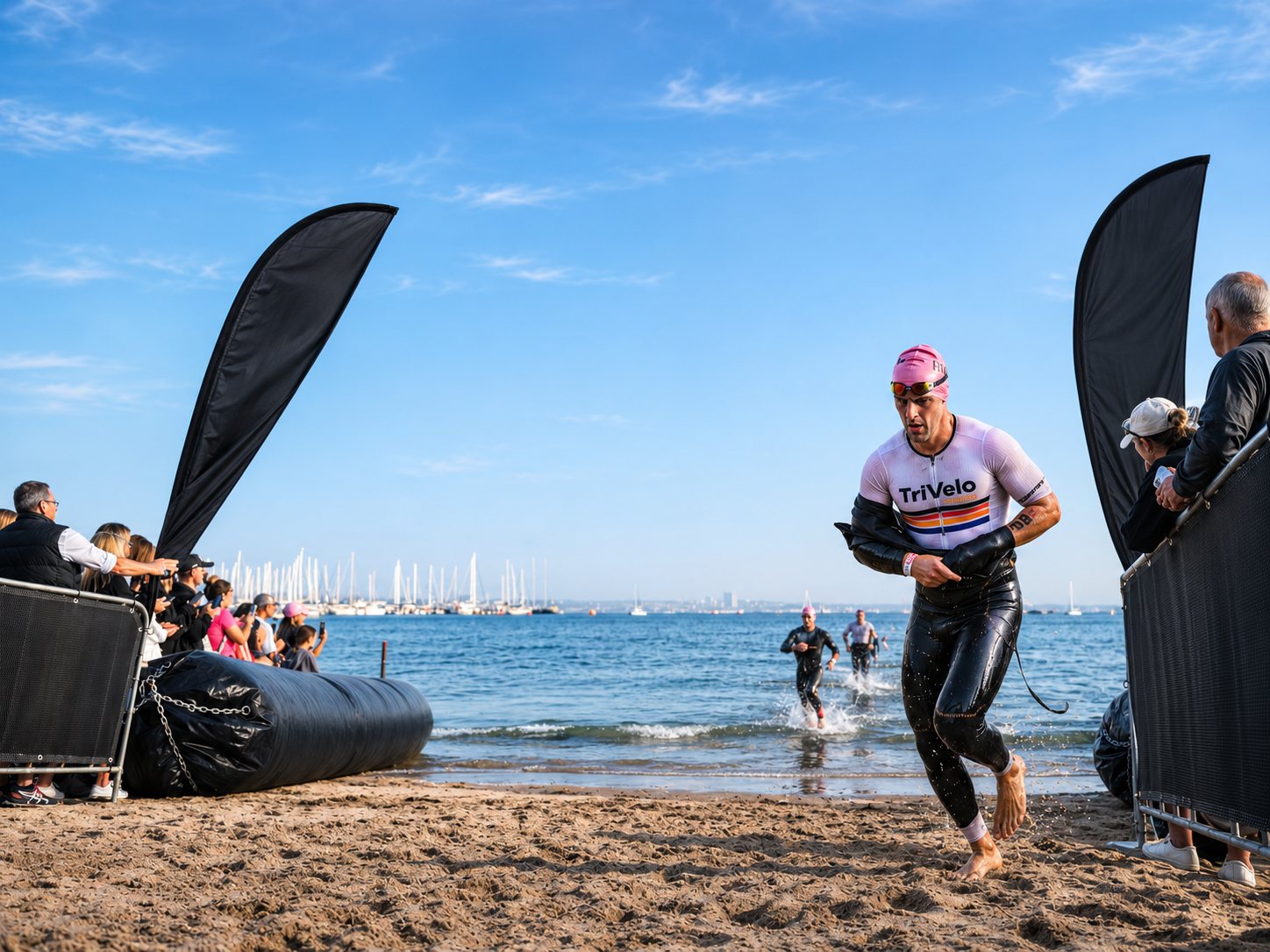
By Gerard Donnelly, head coach at TriVelo Coaching and 1988 Australian Ironman Champion, and coach Jordan Donnelly. From the Get Fast Podcast.
A half Ironman (also called a 70.3) is a 1900 m swim, a 90 km bike and a half marathon run. A good half Ironman training plan has two parts. First you build a base of endurance and strength. Then, somewhere between 10 and 4 weeks out, you start race ready training, where you ride and run at the power and pace you will use on race day. Most intermediate and experienced athletes need four to six months. If you are new to triathlon, allow about six months, and up to a year if you are starting from low fitness.
We don't hand out one fixed 70.3 training plan. Everybody reacts differently to load, and as Gerard puts it, "you can't just throw one program to everybody." What follows is how we build a half Ironman program for the athletes we coach, so you can build yours the same way.
On this page
It depends on the athlete you are today. These are the guides we use.
| Where you are now | Time to prepare for a 70.3 |
|---|---|
| Never done a triathlon, low fitness | At least a year, ideally |
| New to triathlon | About six months. Some people need 12 months. |
| Intermediate to experienced | Four to six months |
| Experienced and already racing often | Eight to ten weeks to get race ready |
Can you do a half Ironman on 12 weeks of training with no experience and poor fitness? Gerard's answer: "Yes, you can get through it. It will be a horrible experience."
Think about which of three goals you have: to complete it, to complete it comfortably, or to complete it with a best time in mind. The more time you give yourself, the further up that list you can go.
If you already have a base, yes. If you are a beginner, usually not.
We don't like athletes coming to us for a six or eight week half Ironman program, because the load can't be increased slowly enough. With a beginner we build from week one to week 25 or 30, and lift the duration by 5 or 10 percent over a few weeks at a time.
Here is a real 20 week example. Harris is a TriVelo athlete from the UK. He works long hours in his family business and came to us as a strong runner and a weak swimmer who had never done a triathlon. His first race goal was a 70.3.
| When | What Harris did |
|---|---|
| First 12 to 14 weeks | Base: endurance, strength and swim technique |
| Last 6 to 8 weeks | Race ready sessions at race power and pace |
| About 6 weeks out | A practice sprint he set up himself at a lake: 750 m swim, 20 km ride, 5 km run |
| 3 to 4 weeks out | An Olympic distance race, his first real race |
| Final 7 to 10 days | Taper |
For Harris, six to eight weeks of race ready work was just enough. A longer race ready period would have been better.
We also don't lock in the weeks ahead. We want to know how you coped this week before we decide what happens next week.
Phase 1: base. Aerobic fitness, endurance and strength come first. On the bike that means long rides and a lot of hills. On the run it means easy long runs with elevation.
Phase 2: race ready. This phase can start anywhere from 10 weeks out to as little as six or four weeks out, depending on your fitness and experience. You do endurance rides at exactly the power and speed you expect on race day, then practise running off the bike.
Work backwards from race day. Ask how long you will be out there for the ride and for the run. Your training has to prepare you for that duration.
The 70.3 swim is 1900 m in a lake, river or ocean. For most age group athletes that is 25 to 45 minutes of straight swimming.
VJ came to TriVelo as a complete beginner and a non-swimmer, six months before his first 70.3. Getting through the swim was his first worry. In the last weeks we took him out of the pool and down to his local beach, where he swam parallel to the shore in water he could stand up in. After four or five of those sessions he could swim the full distance in the time required.
The 90 km bike can take two to four hours on race day.
These sessions show you what speed your race power gives you. On race day you slot into it.
Harris learned this in training. A week after his Olympic distance race he rode a 75 km session at 217 W and could only run for three or four minutes off the bike. A 70.3 bike is almost double the Olympic distance. As Jordan told him, "You cannot try and ride the same watts and expect to be able to run." Harris pulled back 30 W. A week later he ran 16 km off the bike at his 70.3 pace.
Many athletes fall apart halfway through the 70.3 run. The plan is built to stop that.
Lauren (not her real name) came to TriVelo frustrated. She was training hard and not improving, and she wanted to run the whole half marathon in her first 70.3 without walking. We moved her from two runs a week to five, all of them easy. Her weekly running went from 15 to 20 km up to 30 to 50 km. On race day she started the run too fast and faded, and she still ran the whole way.
To estimate your 70.3 half marathon time, double your 10 km time and add 14 to 18 minutes.
Build your race plan from numbers you have already done in training. An example plan: swim at 1:40 per 100 m, ride at 36 km/h based on your power, run at 4:40 per km.
Harris rode the power he had practised in training. He finished the 90 km bike in 2:58 and ran a 1:38 half marathon. We had expected 1:40 to 1:46.
Nutrition is the fourth leg of a half Ironman. If you swim and ride to plan but neglect your nutrition, the run ends the same way as if you had paced it badly.
Taper is individual. Most of our athletes taper for seven to ten days or more. There are no major long or very intense sessions in that time, but there is still some intensity. It is shorter, and the volume comes down. The goal is to shed fatigue. Try your taper across several races to find what works for you.
Don't do any intensity straight after a half Ironman. Recovery takes one to two weeks, depending on your level. Keep moving. Easy coffee rides with friends are ideal, and the more you move after an event like this, the better.

